

Local Development Plan: Vision, Objectives & Options
Chapter 4
Key issues, challenges and opportunities facing Anglesey
4.0 Introduction
The key issues, challenges and opportunities facing Anglesey have been identified by considering national planning legislation, policy and guidance, reviewing the Council’s’ strategic priorities and undertaking initial engagement with stakeholders. Additionally, a review of the Council ’s plans and strategies, as well as Annual Monitoring Reports, has provided valuable insight into the issues that require addressing. The key issues, challenges and opportunities have been grouped by theme.
4.1 Theme: Supporting a Sustainable and Vibrant Economy
4.1.1 The Island has relatively few jobs to support its resident population. Over the last 20 years there have been significant job losses following the closure of major employers, leading to a lot of out-commuting and out-migration:
4.1.2 The Council Plan cites the Economy as one of its six strategic objectives. The Council’s ongoing aim is to support existing businesses, attract appropriate new investment, and increase the number of new businesses, whilst committing to ensuring that the Island continues to have one of the lowest business closure rates across Wales. The commitment to redeveloping former (brownfield) employment sites is clear as is collaboration with landowners to achieve this.
4.1.3 North Anglesey faces economic challenges more than any other part of the Island given the loss of several major employers in the area over recent decades and its relative peripherality and distance from the A55 spine. Accordingly, there is a need to address the economic challenges facing the area so that its future prosperity and wellbeing can be secured. A key opportunity here is the development at Wylfa. The North Anglesey Economic Regeneration Plan outlines a range of interventions to deliver improvements and lasting benefits to the area. The new LDP’s response to the economic situation in North Anglesey will be guided by the principles outlined in the Economic Regeneration Plan.
4.1.4 The need to retain the working age population to stimulate economic and community regeneration is paramount. As such, it is important to nurture and grow local businesses as well as attracting new investment to Anglesey. The new LDP will need to enable business growth through appropriate and proportional employment land allocation.
4.1.5 The securing of Freeport status has the potential to deliver transformational change in communities across Anglesey. With projections suggesting it could create thousands of new jobs, potentially up to 13,000-20,000 by 2030, the new LDP will need to respond to the needs of the Freeport and address issues arising from the granting of status. The commitment to innovation and investment and supporting local talent should provide opportunities to attract significant inward investment to support and diversify the Island’s economic base, whilst creating sustainable and accessible jobs that will contribute to retaining the working age population.
4.1.6 Given the land committed to the Freeport, which will include a large proportion of employment land currently allocated in the Joint Local Development Plan, there is a need to consider and assess the suitability of other land to allocate for general economic purposes.
4.1.7 The need to support and facilitate low carbon energy as a means of contributing towards meeting net zero targets is outlined in the Council Plan under the Energy Island Programme. The Energy Island Programme looks to provide opportunities for jobs, economic growth and prosperity through capitalising on several transformational projects and placing Anglesey at the forefront of low carbon energy research and development. The scope of potential investment in this regard is significant and will undoubtedly realise environmental and economic benefits for the Island in terms of contributing towards lowering carbon emissions and job creation amongst others.
4.1.8 The UK Government purchased the Wylfa site in March 2024. In November 2025 Wylfa was selected as the first site in the UK for Small Modular Reactors. The site will host 3 reactors initially, with scope for an additional 5 reactors in the future. The economic benefits of this project will help towards reinvigorating the north of Anglesey which currently faces several significant socio-economic challenges.
4.1.9 The new LDP will seek to provide a firm policy basis for realising the benefits of major projects whilst ensuring that any adverse environmental impacts that may arise are either avoided or appropriately mitigated.
4.1.10 Anglesey has been designated as an AI growth zone. This status is intended to speed up planning approvals for data centres, give them better access to the grid and draw in investment from around the world.
4.1.11 Given the continuing importance of agriculture and associated services to the Island’s economy, there is a need to address agricultural requirements in addition to opportunities to support, maintain and diversify the rural economy.
4.1.12 The sector must also respond to the challenges set by climate change and nature recovery and, with changes in emphasis to the agricultural subsidy framework, there will be a greater emphasis on the need to diversify businesses to secure their continued viability. A more diverse rural economy will be more resilient to change and better able to sustain rural communities.
4.1.13 Seen as the focal points for the Island’s economic, social and cultural activities, town centres act as hubs for services and facilities that may not be available elsewhere on the Island. The Council ’s Town Centre Improvement Strategy 2023-2028 sets out a framework for improving town centres’ attractiveness, vitality and viability. Town centres have faced a number of serious changes such as the growth in edge or out of town retail, the loss of traditional town centre services such as high street banks and the growth in online retail have significantly challenged town centres. The adoption of a modified approach to town centre regeneration may be appropriate.
4.1.14 Anglesey’s main urban centres of Holyhead, Llangefni and Amlwch have all seen a retraction in “traditional” high street occupation whilst the centres of Menai Bridge and Beaumaris retain relatively vibrant equivalents by comparison. The Council Plan sets out the aim of improving the vitality and viability of Anglesey’s town centres and this can be supported by appropriate policies in the new LDP
4.1.15 The visitor economy is essential to the prosperity of the Island and represents the largest sector of the local economy. The Council Plan outlines the Council’s commitment to invest in infrastructure that will allow visitors to maximise their enjoyment of the Island’s coast and countryside in a safe and sustainable manner whilst the success of cruise ship visits to Anglesey will continue to be supported.
4.1.16 The Destination Management Plan explains the need to manage the growth in tourism in a sustainable way so that long-term prosperity can be achieved whilst mitigating negative environmental and community impacts with a view to safeguarding what makes the Island appealing to visitors in the first instance.
4.1.17 Relevant Sources to support the theme
- North Anglesey Economic Regeneration Plan
- Freeport
- Town Centre Improvement Strategy 2023-2028
- Destination Management Plan
4.2 Theme: Ensuring access to suitable Homes
4.2.1 The Council Plan sets out, as one of its main objectives, the need to ensure that everyone has the right to call somewhere home. The Council will work with stakeholders to identify housing need thereby enabling appropriate provision to meet that need and required tenures.
4.2.2 The average size of households is reducing making it likely that the demand for smaller units will increase.
4.2.3 The Council’s Housing Strategy advises that 62% of local people are priced out of the housing market and, with an ageing population, this means that wide range of housing solutions offering a variety of tenures will be key to addressing housing need.
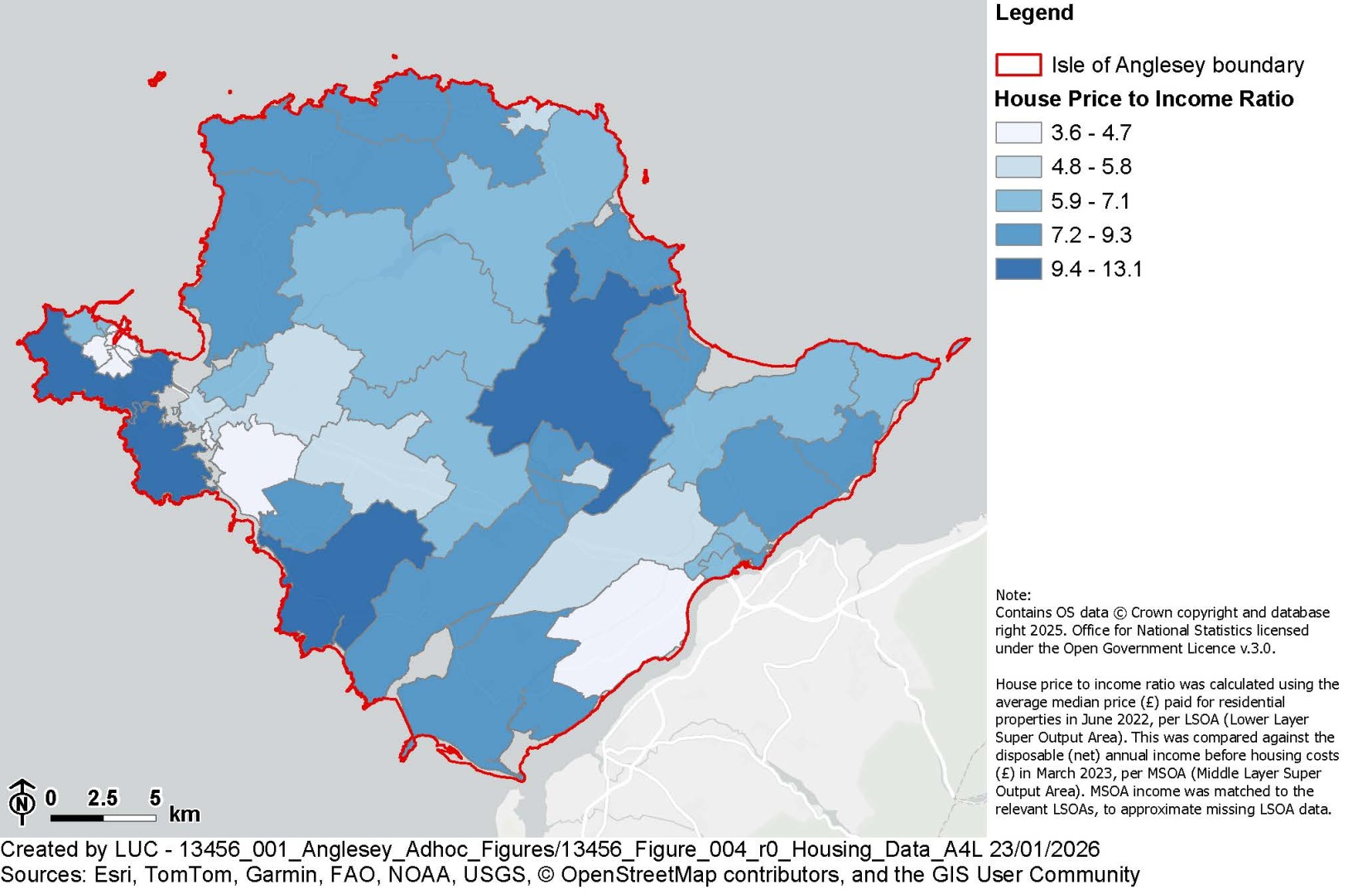
4.2.4 The draft Anglesey Local Housing Market Assessment (LHMA) notes a median house price to median income ration of 7.2 for the Island as a whole, compared to 6.1 in Wales and 5.8 in North Wales. Housing affordability is a key issue that the Plan will need to address.
4.2.5 The severity of the issue is varied across the Island with coastal areas in particular being the least affordable to local residents.
4.3.1 The difficulties experienced by residents wishing to buy or rent homes in their communities has led to new legislation being introduced by Welsh Government that enables LPAs to consider removing or restricting permitted development rights (through the making of a direction under Article 4 of The Town and Country Planning (General Permitted Development) Order 1995) in relation to changing the use of primary homes into second homes or short terms holiday lets. The need to address this issue will necessitate a policy response in the new LDP.
4.3.2 The needs of an ageing population are likely to drive the demand for specialist accommodation where care can be provided for residents. Similarly, people with disabilities and medical needs will have specific requirements for assisted living accommodation that will enable those of higher dependency to live independently within their communities.
4.3.3 The accommodation needs of the Gypsy and Traveller community are outlined in the Gypsy and Traveller Accommodation Assessment (GTAA) 2022. Undertaken for Anglesey and Gwynedd Councils, the GTAA indicates the need for future residential pitches on the Island.
4.3.4 Relevant Sources to support the theme
4.4 Theme: Providing Infrastructure to Support Growth Ambitions
4.4.1 Infrastructure in this context includes transport networks, utilities networks, education facilities (primary and secondary schools), health facilities (GPs, pharmacists), social infrastructure (e.g. community halls), digital infrastructure (internet access) and green and blue infrastructure (parks and open spaces).
4.4.2 Development should be directed to areas that are well-connected to essential infrastructure, be this in relation to mains sewerage and water, gas or electricity. Development should also be directed to areas where access to healthcare and education is readily available. Where development would result in pressure on such services, developer contributions to enable service adaptation should be expected.
4.4.3 Additionally, given the importance placed on digital communication for life and work needs, development should be directed where such connectivity is available or planned. The LDP will consider the opportunities provided by the shift to increased working from home and hybrid working, which could support prosperity and community in more remote areas.
4.4.4 Welsh Government consulted on a potential Third Menai Crossing in 2018, but the project did not progress due to the Government’s decision to halt its road building programmes. Recent occurrences of significant congestion have resulted in the matter being revisited with the report of the North Wales Transport Commission being published in December 2023. The report, whilst not supporting the construction of a new crossing, made several recommendations that will have land use implications should they be implemented. However, the Council rejected the Commission’s findings stating that many of the recommended options upon which the report’s conclusions were predicated had previously been considered by the Council and would not sufficiently address the lack of resilience that exists. Given this, the failure to deliver an improved, multi-modal crossing would compound challenges already faced by the Island’s economy and communities
4.4.5 Llwybr Newydd: The Wales Transport Strategy 2021 sets out a 20-year strategy for sustainable transport whilst responding to the climate emergency. It recognises the need to change the way we travel with reduced dependency on cars and making greater use of public transport, walking or cycling whilst also advocating a reduction in the need to travel. This would be achieved by more home/remote working, better physical and digital connectivity to reduce dependency on cars and transport infrastructure that would support more efficient means of travelling.
4.4.6 All local authorities in Wales must map and plan for suitable routes for Active Travel in their areas and Anglesey’s Active Travel Network Map was approved by Welsh Government in August 2022. The location of development in proximity to Active Travel routes will encourage use thereby delivering health, wellbeing and environmental benefits.
4.4.7 The need to effect change in the way people travel will therefore be a significant consideration in developing policies for the new LDP and the safeguarding of potential active and sustainable travel routes will be paramount to that process.
4.4.8 However, whilst active travel will play a role in some places, as a distinctly rural area with an important role in logistics and distribution linked to the Port, road travel will remain important. As the second largest roll-on roll-of port in the UK, it remains the principal port and fastest route for freight and passenger transfer to and from Ireland. Ensuring the long-term resilience and stability of the Port is critical to socio-economic growth and trade. The Port is critical to the vitality of the Anglesey, North Wales, Welsh, United Kingdom and Irish economies.
4.4.8 Relevant Sources to support the theme
4.5 Theme: Responding to a Changing Climate
4.5.1 The Council declared a climate emergency in September 2020 and made a commitment to be a carbon neutral authority by 2030. It subsequently agreed a “Towards Net Zero Plan 2022-2025”. The Plan commits to the climate emergency and explains how the authority will become a net zero establishment
4.5.2 The Council Plan (2023-2028) reinforces this commitment recognising the need to act in the face of climate change as never having been so vital. In doing so, it commits to consider climate change and biodiversity as fundamental issues when making decisions across the Council’s functions.
4.5.3 Similarly, the Anglesey and Gwynedd Well-being Plan 2023-28 identifies climate change as one of several main priorities for the residents of both counties reinforcing its commitment to support communities to reach net zero targets. The need to act in the face of climate change is therefore seen as a significant issue to address in the new LDP.
4.5.4 The LDP must also facilitate actions and interventions aimed at adapting to climate change. This includes flood resilience measures, manging storm water drainage and coping with the consequences of weather extremes. Nature based solutions and the use of green and blue infrastructure will be encouraged.
4.5.5 Relevant Sources to support the theme
4.6 Theme: Preserving and Promoting Welsh Language and Culture
4.6.1 Cymraeg 2050: Welsh Language Strategy aims to achieve having one million Welsh speakers by 2050. The Council ’s Welsh Language Promotion Strategy 2021-2026 outlines what it proposes to promote and facilitate the use of the Welsh language on the Island. It proposes to reverse the fall in the number of speakers, aiming to increase the number of speakers by 325 over the Strategy’s lifespan. It focuses on three priority areas, namely children, young people and the family, the workplace and the community.
4.6.2 The decline in the number of Welsh speakers can be attributed to numerous factors but uppermost amongst these is the lack of employment opportunities for the younger population, which compels them to look elsewhere for work, and the lack of affordable housing to enable people to live in the communities in which they were raised. There is also a lack of working age people returning to the Island following leaving for higher education, and an increase in in-migration of non-Welsh speaking residents.
4.6.3 Traditionally viewed as a heartland of the Welsh language, numbers of Welsh speakers on Anglesey have decreased in recent years. The new LDP must contribute to addressing the decline through developing robust policies that aim to safeguard and strengthen the Welsh language and culture and promote its use as an essential part of community life. Larger development proposals will require the submission of specific statements or impact assessments to demonstrate the steps that will be taken to protect, promote and enhance the Welsh language.
4.6.4 Relevant Sources to support the theme
4.7 Theme: Protecting the Natural and Historic Environment and the Management of Resources
4.7.1 The Environment (Wales) Act 2016 introduced Section 6 biodiversity and the resilience of ecosystems duty making it incumbent on all public authorities to maintain and enhance biodiversity in the exercise of functions in relation to Wales.
4.7.2 Policy 10 of Future Wales: The National Plan 2040 recognises biodiversity’s role in underpinning “the functioning of healthy, resilient ecosystems and the multiple benefits they provide” and commits to reversing recent losses and enhancing the resilience of ecosystems. The planning system is identified as a key player in meeting this objective.
4.7.3 In response to the Section 6 duty, the Council has prepared and adopted a Biodiversity Plan which aims to ensure the Council maintains and enhances the Island’s varied biodiversity in the exercise of its statutory duties and discretionary activities and, in so doing, promote the resilience of ecosystems.
4.7.4 The new LDP must reflect the commitments made in national legislation and policy and in the corporate Biodiversity Plan to protect and enhance biodiversity whilst strengthening green infrastructure to enable resilience in and connectivity between ecological networks.
4.7.5 Allied to the protection and enhancement of biodiversity is the conservation and enhancement of natural beauty. Most of the Island’s coastline (221km2) is designated a National Landscape (formerly known as an Area of Outstanding Natural Beauty (AONB)). The Anglesey National Landscape Management Plan 2023-28 reinforces the need to conserve and enhance natural beauty and recognises the designated area’s importance to the local economy, environment, culture and well-being of its communities and those who visit.
4.7.6 Anglesey boasts a variety of historic assets including around 1200 listed buildings, 12 designated Conservation Areas, a World Heritage Site and numerous scheduled monuments. The priority is to safeguard these historic assets and to protect them from neglect and decline. As such, the new LDP will provide a strong policy base for affording protection to the historic environment and ensuring that any development proposed in relation to historic assets will be undertaken with the best interests of the asset being the primary concern.
4.7.7 Current policy and guidance stipulate that each Mineral Planning Authority (MPA) meets specific landbank requirements in terms of aggregate provision, this being a 10-year supply in terms of hard rock aggregates and 7 years for sand and gravel. Landbanks must be maintained over the lifetime of a development plan. In practical terms, Anglesey cannot meet the requirement for sand and gravel given that there are no commercial operations on the Island and although sand and gravel deposits occur, they are in areas subject to environmental designations that would make their working unacceptable. In terms of other economic minerals, metal reserves occur at Mynydd Parys and dimension stone is extracted from the Island’s limestone quarries.
4.7.8 The North Wales Regional Technical Statement (RTS) requires that each MPA within the region should contribute an apportioned volume of aggregates to the regional output and should plan accordingly to meet those requirements.
4.7.9 Site restoration is an extremely important consideration to counter the environmental impact of quarrying/mining. Sufficient coverage of this aspect of the post-extraction process will be afforded in the new LDP.
4.7.10 The Waste Hierarchy sets out the priority in terms of responding to the management of different waste streams. The Hierarchy advocates waste reduction, reuse and recycling (including composting) prior to disposal although the diversion of waste from landfilling remains the overarching objective.
4.7.11 The Council’s Resources and Waste Strategic Plan outlines steps to move towards a circular economy which works towards delivering a sustainable response to the management of waste and resource recovery which mirror national objectives encapsulated in the Waste Hierarchy.
4.7.12 The new LDP will need to address the issue of waste management consistent with the aims of the Hierarchy and, where reduction and reuse cannot be achieved, waste should be seen as a resource that can be managed with beneficial outcomes. The new LDP should therefore seek to facilitate increased recycling and composting capacity whilst considering the generation of energy from suitable waste streams.
4.7.13 In order to achieve increased reuse and recycling rates, the appropriate facilities must be available and, while two recycling centres are already operated by the Council, shortfalls in provision have been identified in the Holyhead area, where fly-tipping is a significant problem and in the north of the Island. Similarly, the lack of capacity for inert waste and waste soils management requires that the new LDP addresses these live issues and considers appropriate solutions.
4.7.14 Relevant Sources to support the theme
- Biodiversity Plan
- National Landscape Management Plan 2023-2028
- North Wales Regional Technical Statement
- Resources and Waste Strategic Plan
4.8 Theme: Promoting Placemaking and Wellbeing
4.8.1 The location of development plays a large part in realising the ambition of achieving healthy communities. Healthier lifestyles can be achieved by locating development close to active travel routes and the provision/safeguarding of public open spaces will also contribute towards encouraging a more active lifestyle for residents. The provision of infrastructure to support walking and cycling over dependency on the car can contribute towards meeting health objectives relating to obesity and associated conditions. However, it must be recognised that as a rural island car travel will continue to play a role for most residents.
4.8.2 The need to further consider active and sustainable travel routes and their safeguarding to serve potential new development will be an important feature of the new LDP.
4.8.3 Community facilities are essential to sustain the economic, social and cultural foundation of settlements and communities. Their presence can reduce the need to travel to larger centres and they can contribute to wellbeing in addition to being an essential element of successful placemaking. Their safeguarding from alternative forms of development is essential to help maintain community cohesion and LDP policies should look to support their retention for community use. A related issue is ensuring that there is adequate demand for these facilities by retaining and attracting working families who use these facilities in a variety of ways.
4.8.4 The Gwynedd and Anglesey Wellbeing Plan identifies the need to tackle inequality and disadvantage to close the gap between the most privileged and deprived communities with the following identified by residents as the priorities to address:
- respond to poverty and the cost of living;
- improving the health and well-being of children and young people;
- improve mental health and well-being;
- climate change – support communities to reach net zero targets;
- promote the use of the Welsh Language;
- enable equal experiences and access to nature;
- future workforce planning that meets the needs of the community and the local economy;
- ensure housing for local people; and
- influence the financial priorities of public bodies.
4.8.5 The new LDP should aim to create and maintain inclusive communities that promote health and wellbeing. Through its policies, the LDP should deliver high standards of amenity, foster safe communities with suitable employment opportunities and appropriate homes.
4.8.6 Relevant Sources to support the theme
