

Local Development Plan: Vision, Objectives & Options
Chapter 9
Spatial Options
9.0 Introduction
The LDP has to consider not only the amount of development required (as outlined in Chapter 8) but also where this development should be directed. The decision of where growth should be focused is presented in this chapter through a series of spatial options.
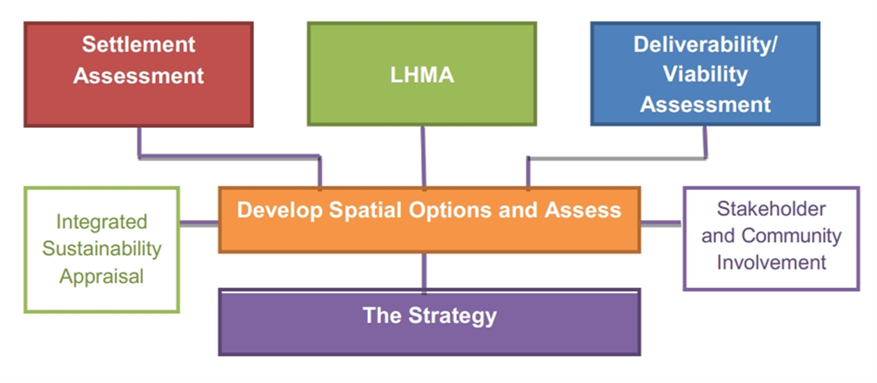
The spatial options presented show how the range of homes and employment outlined in Chapter 8 could be delivered across the Island. The options have been developed based on a number of key inputs as outlined in Figure 9.1 below. They are all considered realistic in that they seek to address the draft objectives of the Plan and are in compliance with national regional and local policy and priorities outlined in Chapter 2. The alternative options provide distinct spatial development scenarios which would have different environmental, social and economic outcomes for the Island.
At this stage in the LDP preparation no specific sites have been selected
9.1 Proposed options
Spatial Option A: Focus on key settlements
Description
9.1.1 Option A would focus development on the primary key settlements (Sub-regional service centres and urban service centres) of Holyhead, Llangefni, Amlwch and Menai Bridge. It is a broad continuation of the existing spatial strategy set out in the existing JLDP. However, the classifications of some settlements have changed as result of the updated Settlement Study. Holyhead has been reclassified as a Sub-regional centre and Menai Bridge has been upgraded from a Local Service Centre to an Urban Service Centre.
9.1.2 This option would distribute new growth mainly to large sites in or around Holyhead, Llangefni, Amlwch and Menai Bridge, and to small to medium sized sites in the majority of Local Service Centres and Villages in the LDP area. There would be a focus on brownfield sites and regeneration of urban centres. Growth in all the other settlements would be limited to the current landbank supply, windfall sites, adapting existing units, and the rounding off of settlements. This approach would be commensurate with the size, role, character and environmental capacity of the settlement.
Key features
- Supports the aims and objectives of Future Wales by acknowledging Holyhead as the main settlement on the Island.
- A significant proportion of employment sites are located in these four key settlements.
- Opportunity to deliver higher density development in urban areas which reduces land required to meet growth needs.
- Heavy reliance on brownfield urban land. This may pose remediation and viability challenges. Sufficient brownfield sites may not be available to fulfil growth needs.
- Most of the market and affordable housing would be delivered in a limited number of key settlements with limited development being directed to ‘smaller’ settlements and rural areas leading to a potential failure to meet developmental needs of rural communities.
- Urban focus is likely to enhance sustainable transport use generally focused within accessible urban locations.
- Delivery of larger scale sites is more likely to support substantial infrastructure requirements than a larger number of smaller sites.
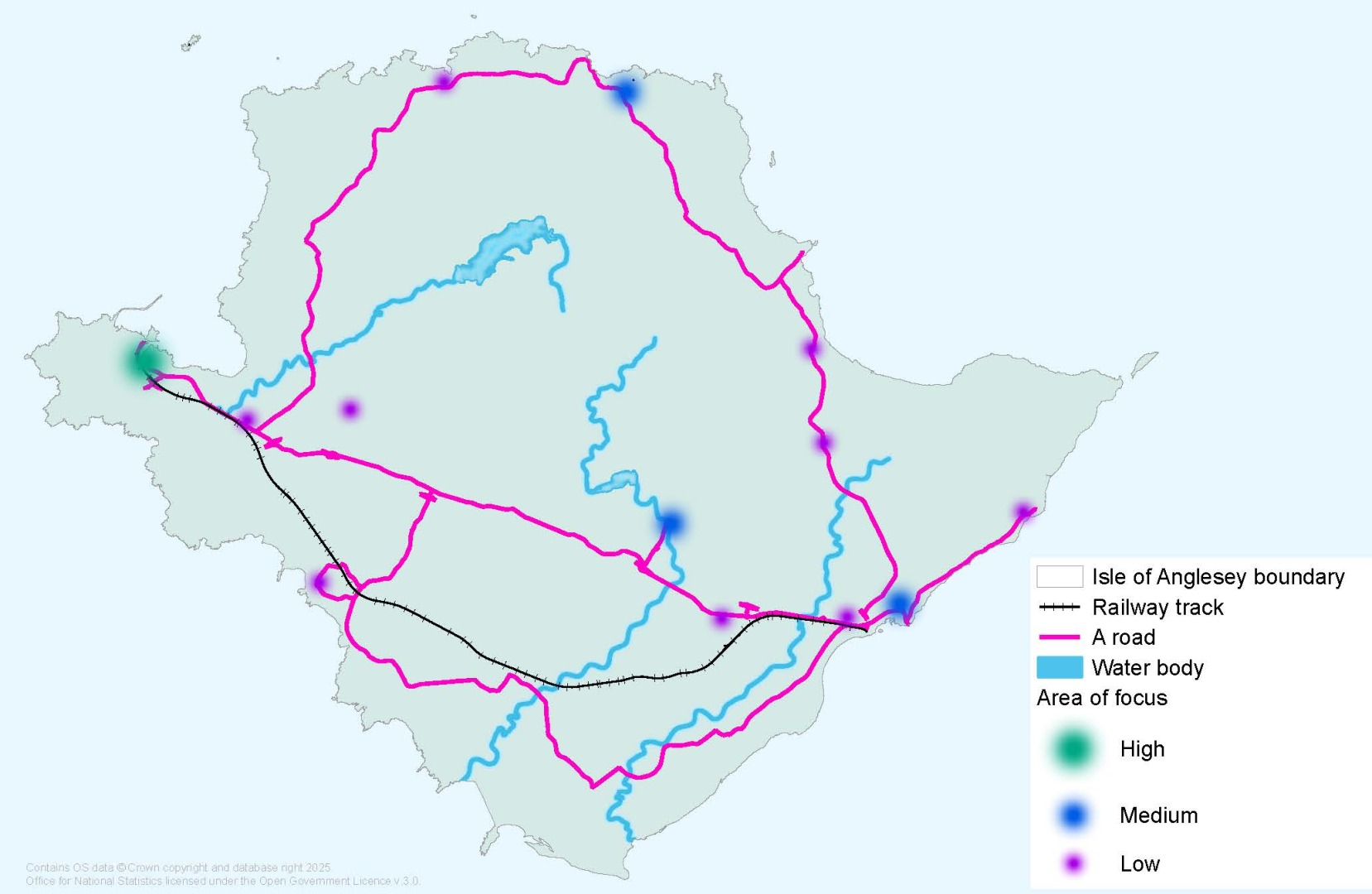
Spatial Option B: Dispersed Development
Description
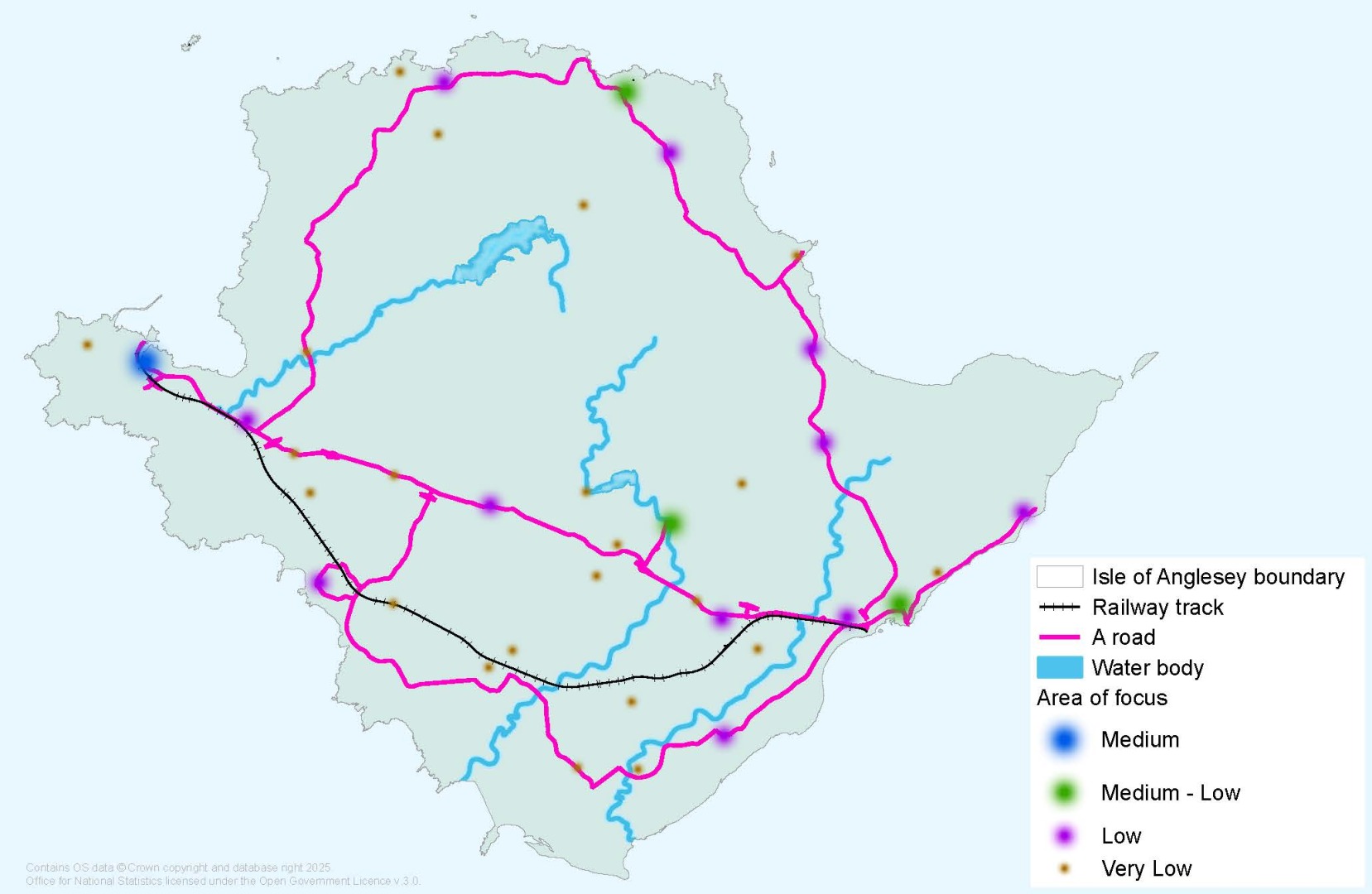
9.1.3 This option would disperse development across all settlements at a level that is proportionate to the size of each settlement based on the population within each settlement, similar to Option A. However, this Option would give more focus to rural communities and disperse more of the new growth to all settlements, the area’s villages, rural villages and clusters than identified in Option A
9.1.4 The number of new homes allocated in each settlement would reflect the size of the settlement, based on the number of dwellings/population that were currently within that settlement. Considerably less growth would be directed to Holyhead, Llangefni, Amlwch and Menai Bridge and the Primary Key Settlements than all the other options.
Key features
- Development would be shared equitably across the Island, proportionate to the size of the settlement, this could help strengthen the vitality of more settlements and reduce patterns of social exclusion and isolation.
- Potential for wider distribution of employment opportunities in rural areas.
- Development spread across a wider area would potentially mean people are located further from services and facilities.
- High pressure to develop on greenfield land which may have impacts on environmental assets and landscape features.
- Provides the greatest range of sites and opportunities for developers, particularly for residential developments.
- Would contribute towards national and local priorities for sustainable rural communities, addressing rural depopulation and demographic challenges.
- Would limit the use of urban brownfield sites.
- Maximised distribution of affordable housing
- Reduced opportunities for strategic place making and delivery of large scale infrastructure improvements
- Likely issues with delivery of sustainable connectivity and active travel. People are likely to have to travel more, within limited sustainable options
Spatial Option C: Transport Corridor Focus
Description
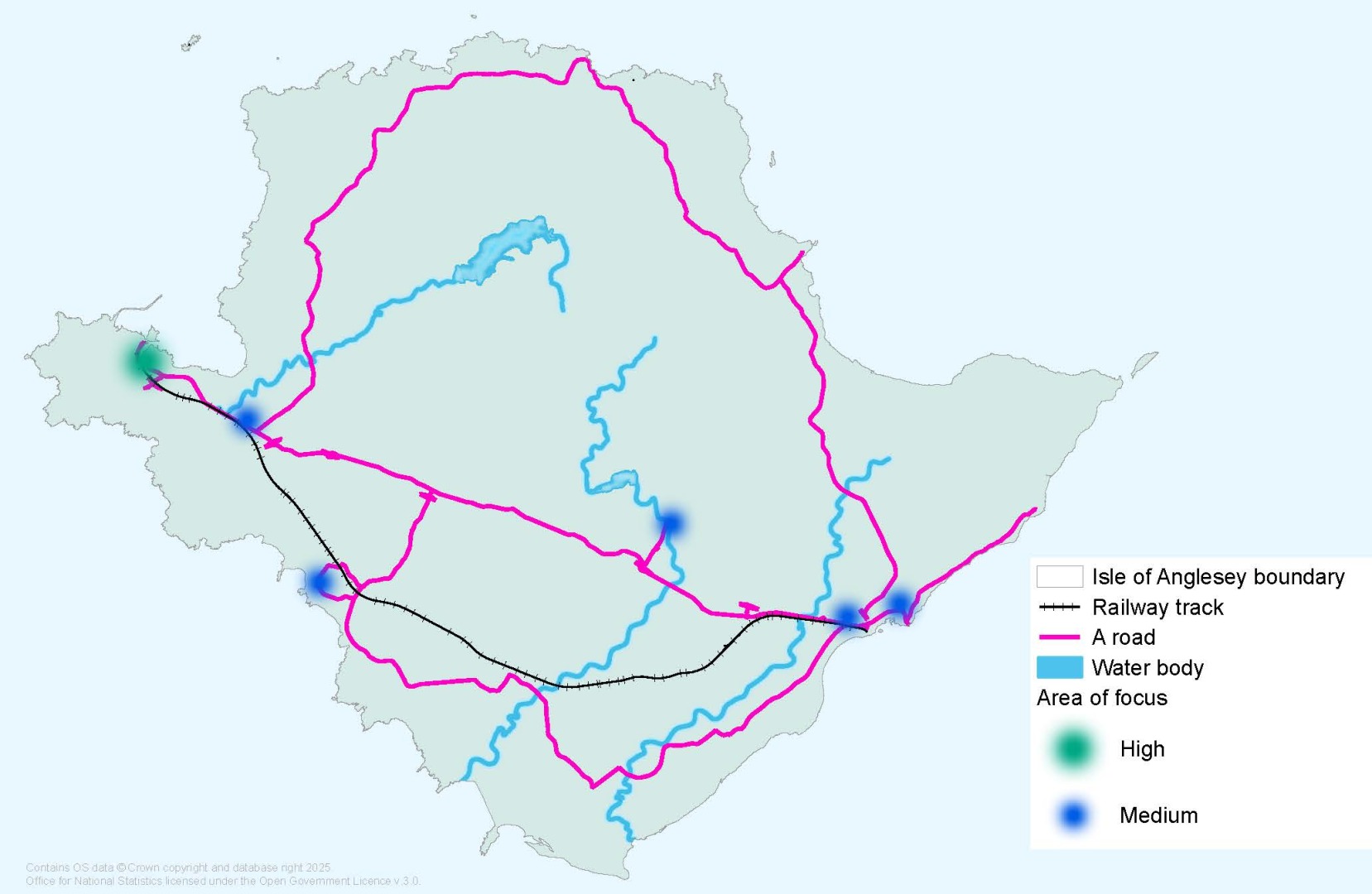
9.1.5 This option would focus development along the A55 corridor which runs from Menai Bridge to Holyhead. It would also favour sites that have easy access to public transport hubs at Holyhead, Llangefni, Llanfairpwll, Bodorgan, Ty Croes, Rhosneigr, and Valley. A proportionate distribution of development would be directed across these key settlements. This option would distribute a higher proportion of growth to Holyhead, Llangefni, and Menai Bridge (as key access points to the A55), as well as Local Service Centres and Villages within or near to the public transport hubs.
Key features
- The A55 corridor correlates with 3 of the 4 key settlements of Holyhead, Llangefni and Menai Bridge. However, this option would not maximise development in Amlwch which is a key settlement in the Settlement Hierarchy
- Most of the existing employment sites are located within or in close proximity to the A55 corridor.
- Focus on road access may encourage unsustainable forms of travel to be most attractive.
- Ignores the role of sustainable settlements elsewhere in Anglesey.
- Would support the North Wales Regional Transport Plan 2025-2030 (Draft) which encourages an urban planning strategy that focuses on creating high-density, mixed-use development around public transport hubs.
- Most of the market and affordable housing would be delivered in a limited number of settlements, potentially leaving some areas with unmet needs.
- Focusing growth around sustainable transport hubs would reduce the need to travel by car and may encourage modal shift.
9.1.6 Your views and comments will help us to select the Preferred Spatial Strategy for the new LDP. The preferred spatial strategy may be one of the options presented here or a combination of them. Following this consultation we will consider all comments received, alongside the proposed sites (submitted via the call for sites), the emerging evidence base and input from key stakeholders to select the preferred strategy.
